Guide · Calming exercise for dementia
The 10-minute calm-down for restless, pacing days
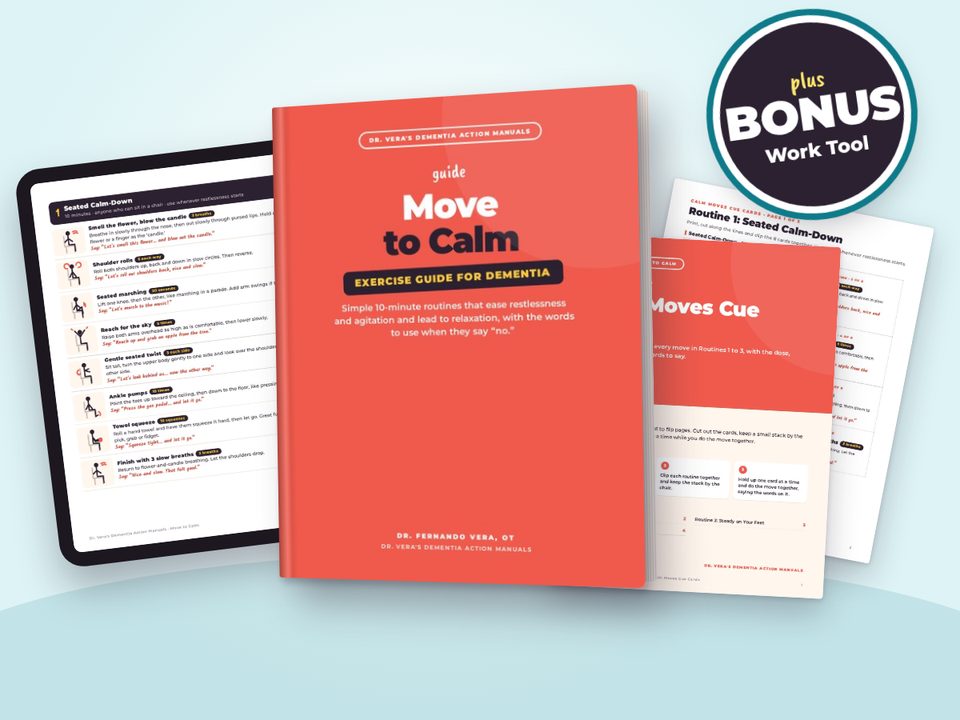
Move to Calm Exercise Guide for Dementia
Five gentle routines that ease restlessness, from a seated calm-down you can use the moment fidgeting starts to an evening wind-down for the 3 to 5 p.m. hours. Every move comes with the exact words to say, plus what to do when they say "no."
One payment. Instant download. 30-day money-back guarantee.
- 5 gentle routines, most about 10 minutes
- Words to use when they say "no"
- By a licensed occupational therapist
Sound familiar?
When the restlessness has nowhere to go.
- They pace the hallway for an hour and can't tell you why.
- Their hands pick, grab and fidget all afternoon.
- By 4 p.m. they are wound up and nothing settles them.
- You ask, "Do you want to exercise?" and the answer is always no.
- They nap all day, then wander the house at night.
- You want to help them move, but you're scared they'll fall.
It's not your fault. Nobody showed you how to turn restless energy into calm.
The shift that changes everything
A body that moves is a brain that settles.
Much of the pacing and fidgeting is restless energy with nowhere to go. Give it a gentle, safe outlet, and invite them instead of asking. Here's how it looks:
The problemThey're restless, but refuse to exercise
Come march with me to this song.
Do you want to exercise?
Why it works: An invitation is easier to join than a yes-or-no question they can refuse.
The problemThey need to move more, but won't budge
I need your help folding these towels.
You need to move more.
Why it works: A familiar task gives movement a purpose they care about.
The problemThey're tiring halfway through
That's perfect. Let's rest.
Come on, just five more.
Why it works: Stopping while it still feels good means they'll want to do it again.
Look inside
Scroll through the guide.
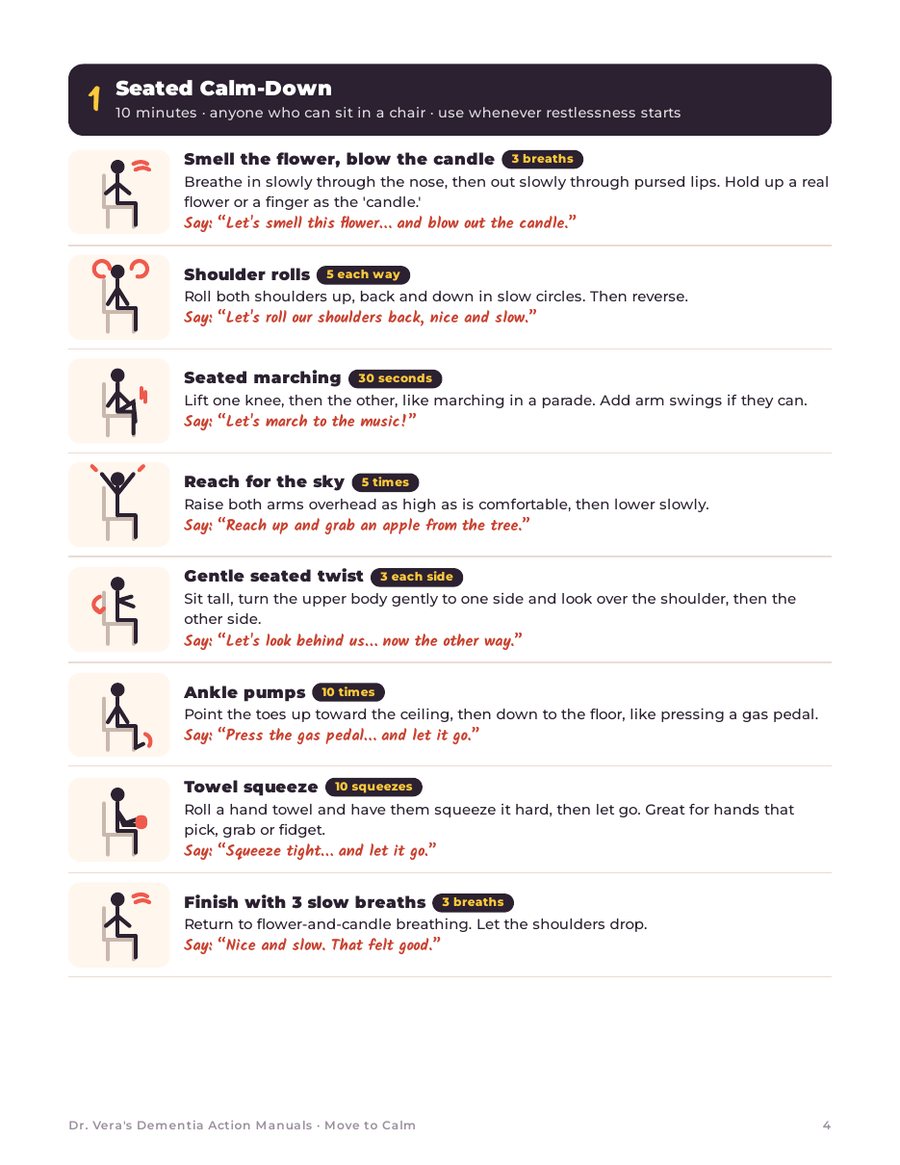
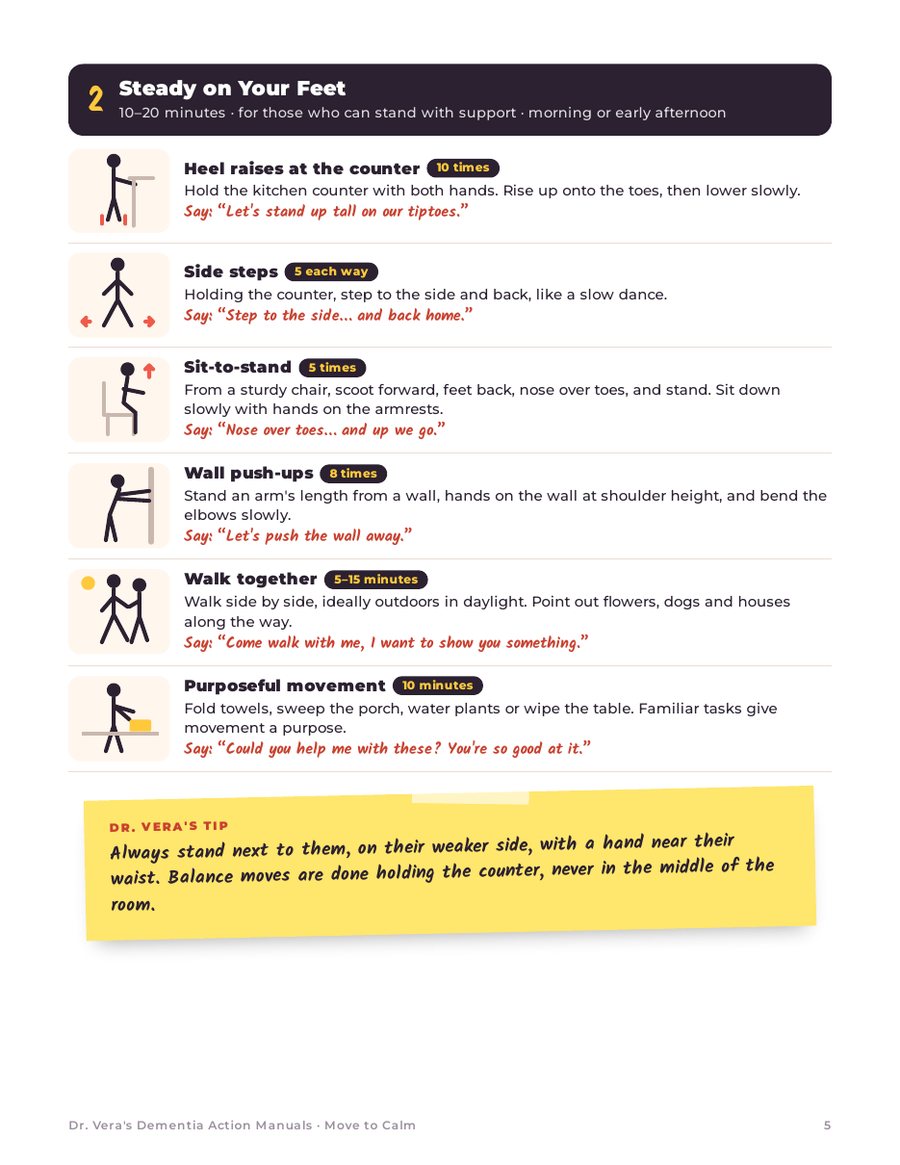
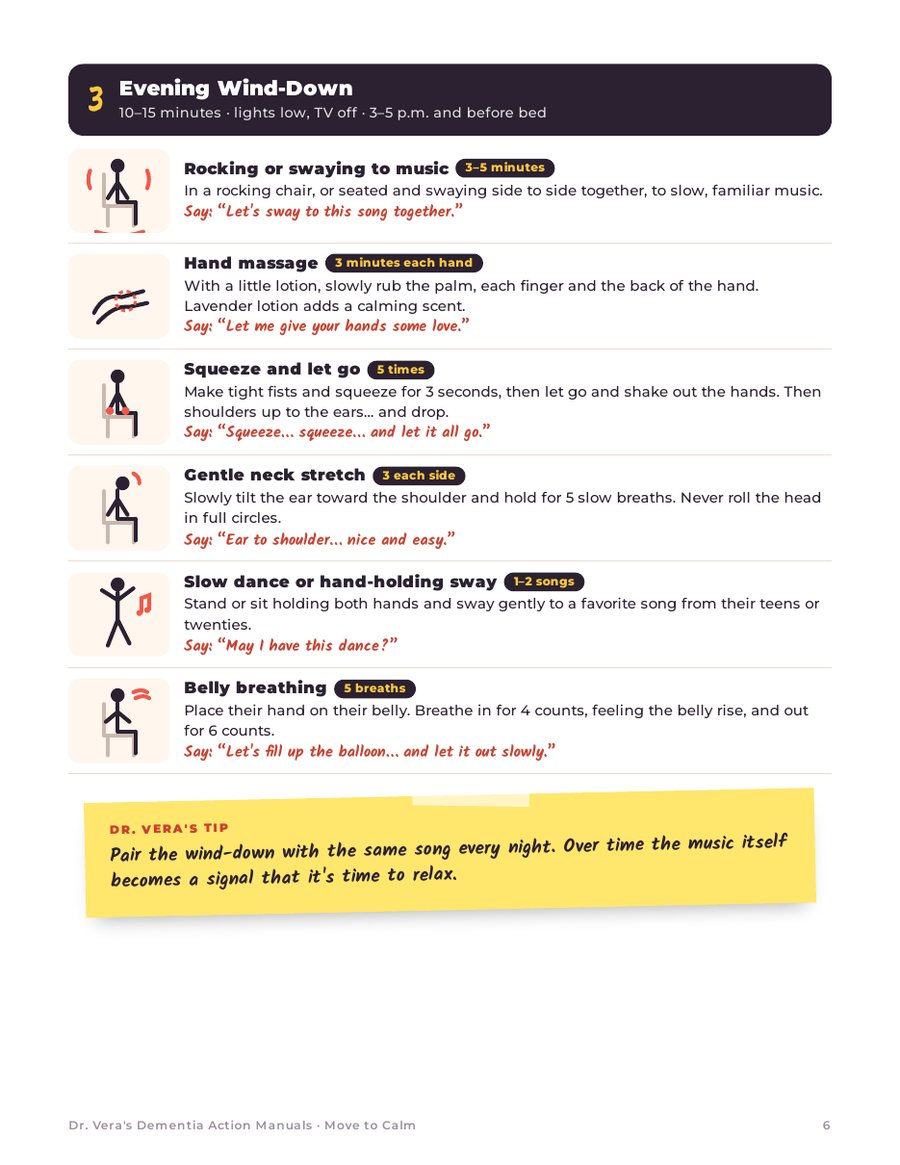
Each routine is one page: how long it takes, who it's for and the best time to use it. Every move has a dose, a one-line how-to and the exact words to say, so you can follow along while you do it together.
Tap a page to see it full size.
- A clear dose for every move, like "5 times" or "30 seconds"
- One-line how-to you can read at a glance
- The exact words to say for each move
- Safety checks and when to stop right away
- A sticky-note tip from Dr. Vera
Without a plan
- You ask if they want to exercise, and they say no
- Restless energy builds into a 4 p.m. meltdown
- You don't know which moves are safe
- You explain a move, and they get confused
- The evenings run long and the nights run longer
With Move to Calm
- You invite them with words that work
- A 10-minute routine at 2:30 p.m. heads off the hard hours
- You know the safety rules and when to stop
- You show the move and they copy you
- The same song each night signals it's time to relax
This guide is for you if…
- You care for someone with dementia who paces, fidgets or gets restless
- Late afternoons and evenings are the hardest part of your day
- You want simple moves you can do together at home, with no equipment beyond a chair, a towel and some music
- Your loved one is in any stage, from daily walks to resting in bed
- You want the words to use when they say no
It's not for you if…
- You're looking for a medical exercise program or physical therapy
- You want a workout for fitness or weight loss
- You want a promise to cure or reverse dementia
Aides and family can use the same routines and the same words, so every caregiver gives the same calm cues.
Everything inside
What's inside the guide
5 routines, 33 gentle moves, and the help you need when it doesn't go to plan.
Read this first 4
- Why movement calms
- When to use each routine
- Safety first
- The 4 golden rules
Routine 1: Seated Calm-Down 8
- Smell the flower, blow the candle
- Shoulder rolls
- Seated marching
- Reach for the sky
- Gentle seated twist
- Ankle pumps
- Towel squeeze
- Finish with 3 slow breaths
Routine 2: Steady on Your Feet 6
- Heel raises at the counter
- Side steps
- Sit-to-stand
- Wall push-ups
- Walk together
- Purposeful movement
Routine 3: Evening Wind-Down 6
- Rocking or swaying to music
- Hand massage
- Squeeze and let go
- Gentle neck stretch
- Slow dance or hand-holding sway
- Belly breathing
Routine 4: Morning Wake-Up 7
- Good-morning breaths
- Open and close the hands
- Drink the coffee
- Kick the ball
- Heel and toe taps
- Pick the apples
- Big morning stretch
Routine 5: Bed-Level Calm 6
- Breathing together
- Warm hand massage
- Helping elbow bends
- Ankle circles
- Heel slides
- Foot rub
When it's hard 4
- When they say "No"
- Matching movement to the stage
- Calming music & rhythm
- Troubleshooting: what if…
Print and use 1
- My weekly movement plan
Try these tonight
Breathe in slowly through the nose, then out slowly through pursed lips. Say: "Let's smell this flower… and blow out the candle."
Why: Slow breathing is an easy first step anyone can copy.
Roll a hand towel and have them squeeze it hard, then let go, 10 times. Say: "Squeeze tight… and let it go."
Why: Great for hands that pick, grab or fidget.
Hold both hands and sway gently to a favorite song from their teens or twenties. Say: "May I have this dance?"
Why: Rhythm and a familiar song settle the evening.
Bonus with your order
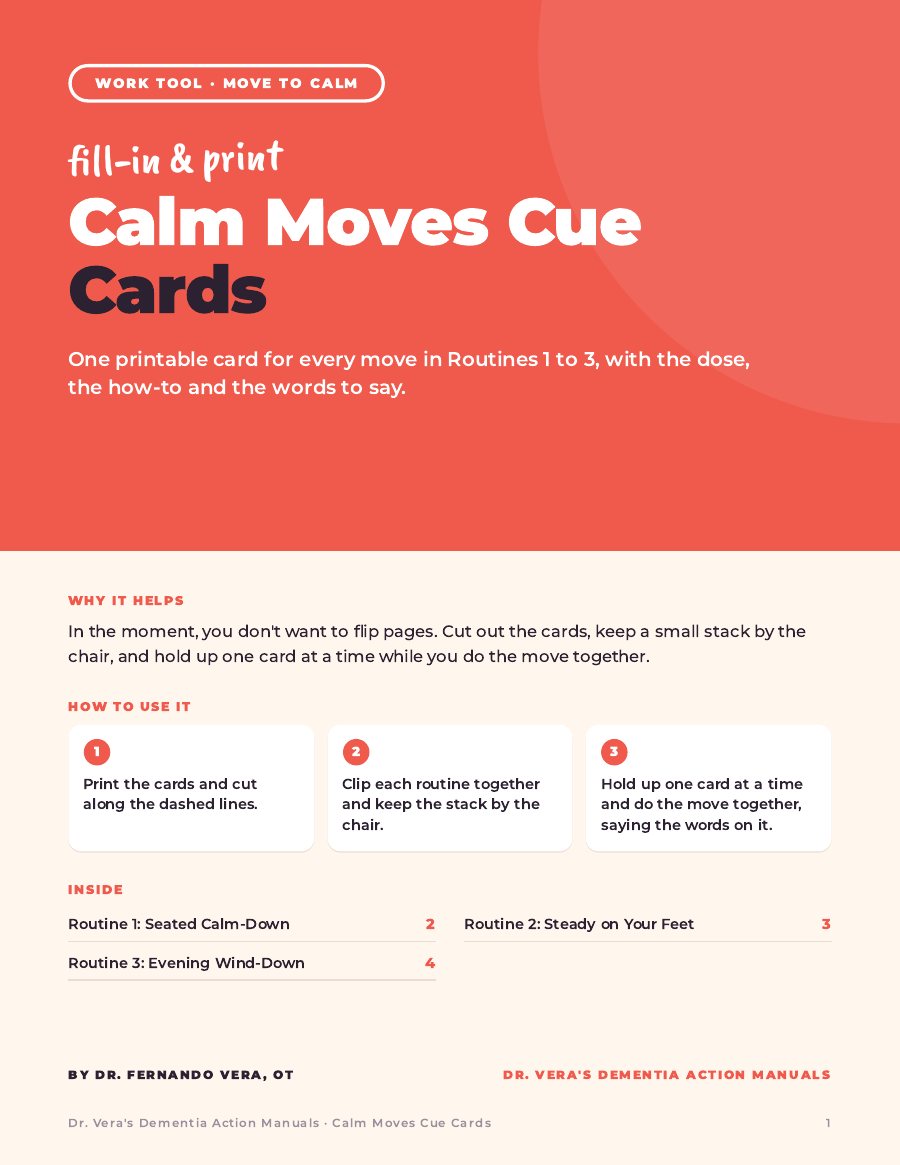
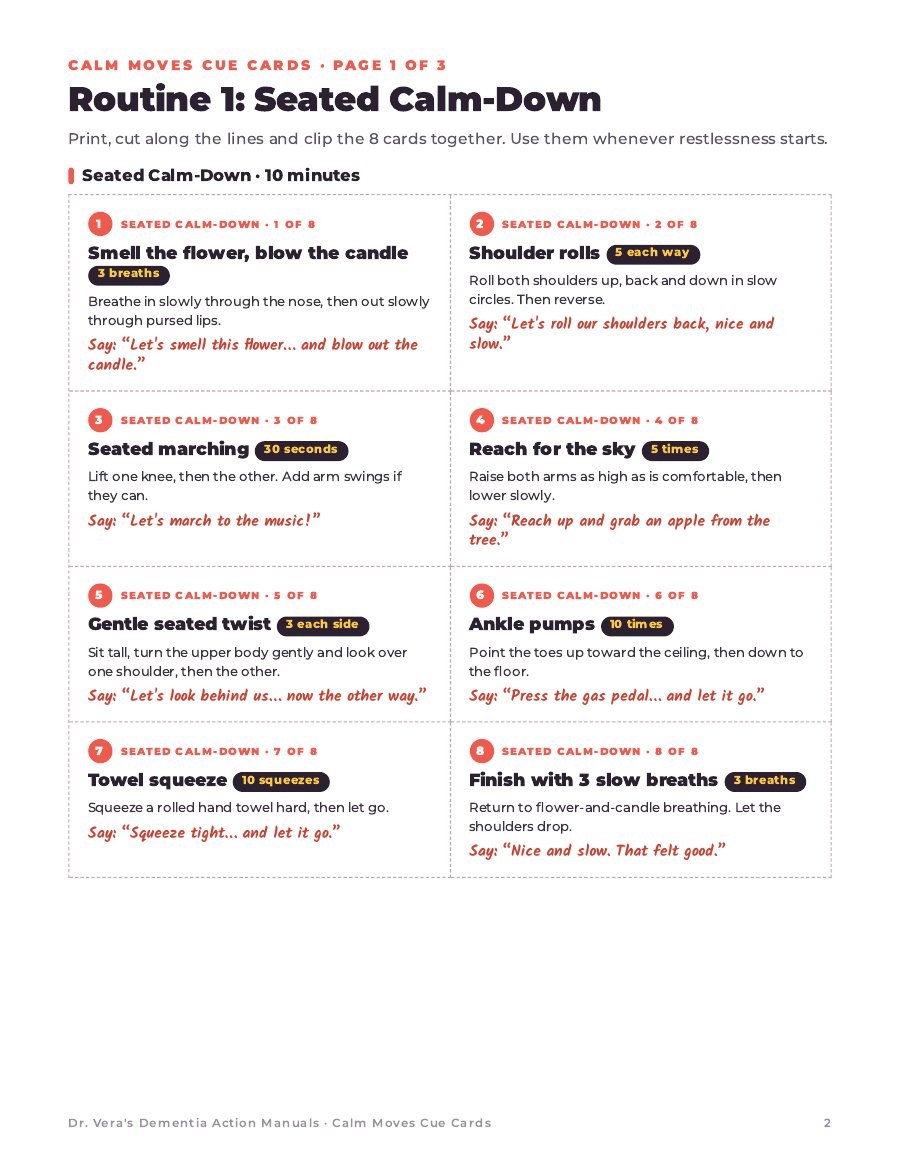
Calm Moves Cue Cards
One printable card for every move in Routines 1 to 3, with the dose, the how-to and the words to say.
In the moment, you don't want to flip pages. Cut out the cards, keep a small stack by the chair, and hold up one card at a time while you do the move together.
Inside the work tool:
- Routine 1: Seated Calm-Down
- Routine 2: Steady on Your Feet
- Routine 3: Evening Wind-Down
Fill-in PDF. Print it, or fill it in on a tablet.

Meet your guide
Dr. Fernando Vera, OT
Licensed occupational therapist and dementia educator in The Woodlands, Texas. He helps families through dementia challenges every week.
His mother, Virginia, was healthy and active when she was diagnosed with a fast-moving dementia. Even with his training, some days he didn't know what to say. These manuals are the answers he wished he'd had.
Everything you get
Move to Calm
Exercise Guide for Dementia
- Move to Calm: the complete 12-page guide
- 5 gentle routines, from seated to bed-level
- Words to use when they say "no"
- Calm Moves Cue Cards: 20 printable cards
- BONUS: Calm Moves Cue Cards (fill-in work tool)
$17 one-time payment · instant download
One payment. Instant download. 30-day money-back guarantee.
- 30-day money-back guarantee
- Instant PDF download
- Pay once, no subscription
Try it for 30 days. All the risk is on me.
Use it at home. If it doesn't help you handle hard moments with more confidence, email us within 30 days for a full refund. No forms, no hard feelings, and you keep the bonus work tool.
Dr. Fernando Vera, OT
Questions
Before you buy
Is this a physical book?
No. It's a short digital PDF guide you can download right away, read on any device, or print at home.
Can I use it on my phone?
Yes. The PDF opens on any phone, tablet or computer. Many caregivers keep it on their phone and print the cue cards to keep by the chair.
How long does it take?
The guide is 12 pages, so you can read it in one sitting. Most routines take about 10 minutes. Steady on Your Feet runs 10 to 20 minutes, and the Evening Wind-Down 10 to 15.
What stage is it for?
Every stage. A page matches moves to early, middle and late stage, and the Bed-Level Calm routine is made for people who spend most of the day in bed.
How is this different from free exercise videos?
Most exercise videos are made for people who can follow instructions. This guide is built for dementia: you move together, show instead of explain, and use one short phrase per move, with words for when they refuse.
Can I share it with family or aides?
Yes, please share it with the family members and aides who help care for your loved one, so everyone uses the same routines and words. Please don't post or resell it publicly.
Is this medical advice?
No. It's practical, educational guidance from an occupational therapist. Check with their doctor before starting, especially with heart or lung disease, recent falls, joint replacements, dizziness or new pain.
What if it doesn't help?
You're covered by the 30-day money-back guarantee. Email us within 30 days for a full refund, and keep the Calm Moves Cue Cards.
Ready for calmer afternoons?
Move to Calm plus the bonus work tool, as an instant download.
Education, not medical advice. Written by Dr. Fernando Vera, a licensed occupational therapist and dementia educator who helps families through dementia challenges.
Goes well with
More tools for the same problem.
 Free
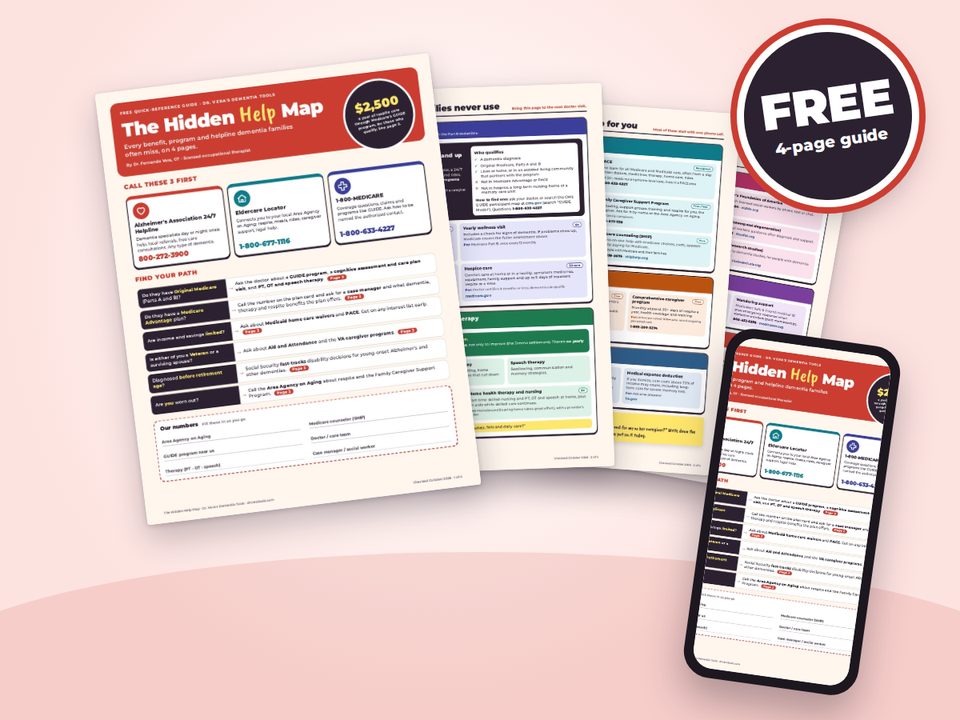
Find the help you may be missing
The Dementia Resource Map
Every benefit, program and helpline dementia families often miss: Medicare's GUIDE program, VA benefits, Medicaid home care and more, in large, easy-to-read print.
 Free
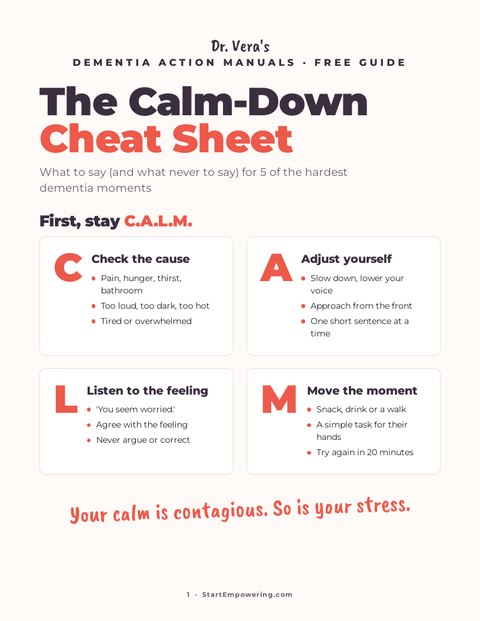
What to say in 5 of the hardest moments
The Calm-Down Cheat Sheet
What to say, and what never to say, in five of the hardest moments. Print it for the fridge.
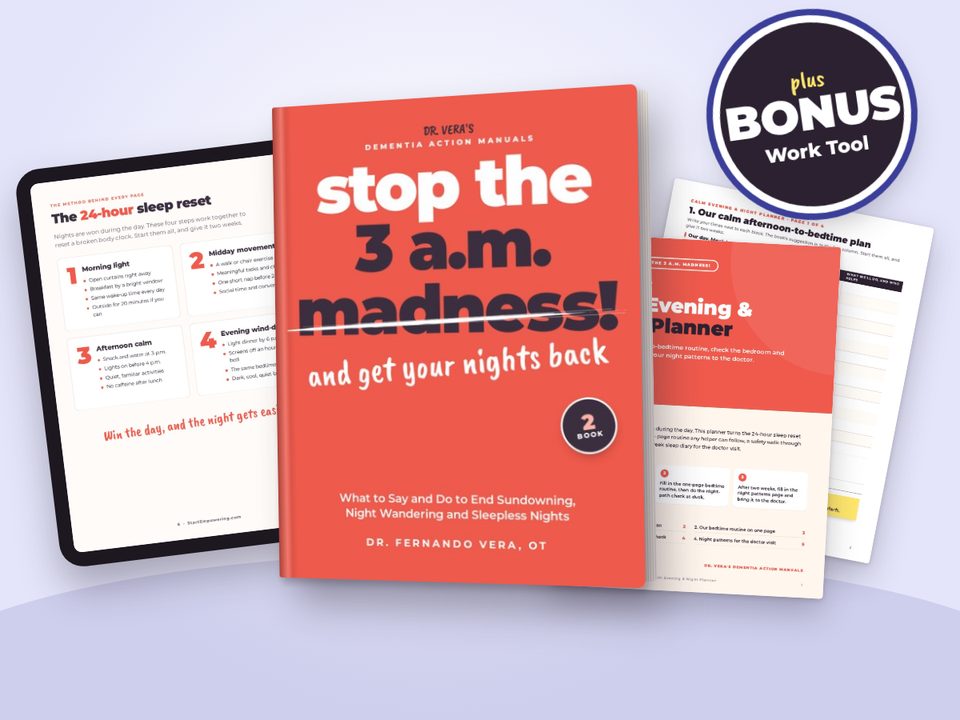
A plan for sundowning and sleepless nights
Stop the 3 A.M. Madness!
What to say and do to end sundowning, night wandering and sleepless nights.
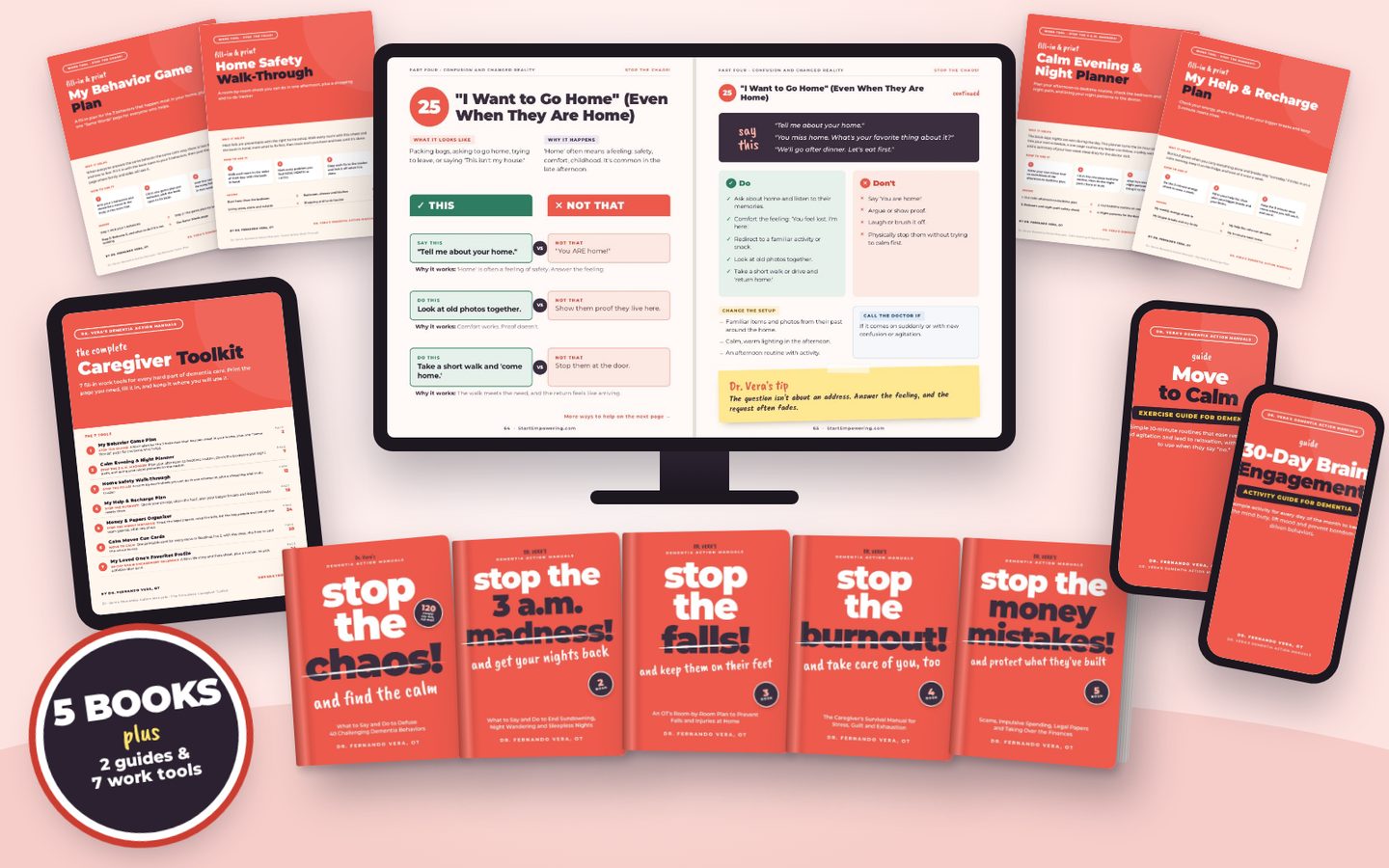
All five manuals, one for each hard part
The Five-Book Collection
All five manuals: behaviors, nights, falls, your own stress and money.